Manifestation FAQ
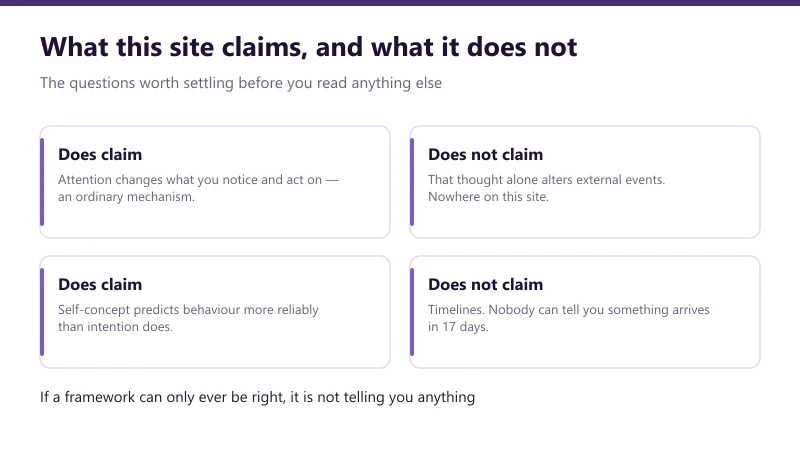
The objection we take most seriously, defined by its own field — see Confirmation bias in the APA Dictionary of Psychology. The six things we have committed never to claim are listed in full on the about page.
Including the answers that do not help us sell anything.
What is manifestation?
Manifestation is the practice of getting clear about an outcome you want, holding your attention on it deliberately, building an identity around the behaviours it requires, and acting in ways that move you toward it. In practical terms it combines goal clarity, visualization, self-concept work, emotional regulation and consistent action. It does not mean thoughts alone produce external events.
Is there any evidence behind manifestation?
The parts of manifestation that have real support are the ordinary ones: clear goals outperform vague intentions, mental rehearsal improves performance on the thing you rehearse, expectations shape what you notice and attempt, and consistency compounds. What has no evidence behind it is the claim that thinking about an outcome causes the universe to deliver it. A practice built on the first list is useful. A practice built on the second usually ends in disappointment.
How do I start manifesting if I am a complete beginner?
Define one goal in a sentence a stranger could understand. Choose one method that matches how you naturally connect with a goal — seeing it, writing it, saying it or doing it. Pick one daily action you can complete in under fifteen minutes. Do both for thirty days without changing the goal. That is the entire beginner protocol, and it beats collecting ten techniques.
When should I expect to see something change?
Nobody can honestly tell you, because the outcome depends on factors beyond your intention — including your actions, your starting point and circumstances outside your control. What has a timeline is the practice: attention and behaviour usually start shifting within two to four weeks of consistent work, and that shift is what makes external change more likely.
I have been doing this for weeks with nothing to show for it — what now?
Usually one of four things: the goal keeps changing, doubt arrives right after the vision and stops the behaviour, the practice collapses once the initial excitement fades, or the practice never converts into real-world action. Each of those needs a different fix, which is why adding another technique so rarely helps. The free quiz identifies which one your answers point to.
Can I manifest a specific person?
No — not ethically and not reliably. Another person's feelings and choices are theirs. What you can work on is your self-concept, your standards, how you communicate, which relationship qualities you are actually looking for, and the social behaviour that puts you around people who match them. That is what our love guidance focuses on.
What is the best manifestation method?
There is no single best method — there is a best fit. Someone who thinks clearly on paper gets far more from scripting than from silent visualization. Someone whose gap is action needs an execution layer, not another mental practice. The right question is which combination fits you, which is exactly what the quiz and Manifestation OS are built to answer.
Do I need to believe in the law of attraction?
No. Everything on this site works as attention training, self-concept work, goal-setting and behaviour design. If a spiritual framing is meaningful to you, it fits comfortably alongside that. If it is not, nothing here requires it and you can exclude spiritual language from your personalized system entirely.
Is the manifestation quiz free?
Yes. Four questions, about sixty seconds, no email required, and the full result is free. There is one paid product on the site — Manifestation OS at $19, one time — and it is entirely optional.
What is Manifestation OS?
A personalized 30-day manifestation system built from your goal, your pattern, the method that fits you and your real-world action style. It includes your method stack, identity work, scripts, affirmations, a guided visualization with audio, a vision board blueprint, a 30-day calendar and printable tools. One payment of $19, no subscription.
Do vision boards work?
A vision board works to the degree it keeps the vision connected to your actual life. As a daily attention cue tied to specific behaviour, it is useful. As a collage you make once and stop seeing, it does very little. That is why our blueprint decides what each part of the board has to represent before a single image is chosen.
How is this different from every other manifestation site?
Most manifestation content stops at "here are the methods" and leaves you to guess which apply to you. We start by identifying how you actually pursue goals, then build the combination around it — and we include real-world action, which most manifestation products leave out entirely.
Do you guarantee results?
No, and we will not pretend otherwise. Manifestation practices do not guarantee specific outcomes, are not a substitute for professional medical, financial, legal or mental-health advice, and cannot influence another person's choices. What we can do is make your practice specific, consistent and connected to behaviour you control.
Which method should I start with?
Pick one that matches how you actually think rather than the one with the best testimonials. If you work things out in pictures, visualisation-led methods — scripting, SATS, mental rehearsal — give you something to hold onto. If you work things out by writing, the letter method or a written mental diet will serve you better, and if you cannot form mental images at all (some people genuinely cannot) the visual methods will feel like failing at step one, which is a difference in cognition rather than effort. And if you are sceptical by temperament, start with the plainest version available — outcome written down, attention directed deliberately, one action scheduled — because performing a ritual you find silly interrupts the state it was supposed to produce.
How do I know whether it is working?
Track three things daily for four weeks: whether you did the practice, one line on what you noticed, and one line on what you did about it. Almost nobody records anything, which is why "it is not working" is usually said without evidence. The record tends to reveal something specific and fixable — noticing went up and action did not — and you cannot see that from memory. Belief strength is the one thing not worth tracking: it fluctuates daily and predicts nothing.
Is this just confirmation bias with extra steps?
Partly, and that is less dismissive than it sounds. Confirmation bias reliably changes what you notice, and a practice that deliberately aims it at something you chose is doing something real even if the something is ordinary — you start seeing opportunities that were always there, early enough to act on them. What the objection correctly rules out is the stronger claim that attention alone alters external events, and we do not make that claim anywhere on this site.
How is this different from ordinary goal setting?
The overlap is large and worth admitting. The difference is where each starts: goal-setting frameworks begin at planning and treat self-concept as a side issue, while these methods begin at self-concept and treat the plan as downstream. For someone whose actual obstacle is "I do not believe I am the kind of person who does this", starting at the plan has a poor track record — the plan gets made and then quietly not followed.
What if I keep doubting?
Then you are practising correctly. Advice to never think a negative thought creates a monitoring loop: you end up watching for the thought, which is a reliable way to produce it. Doubt is not a leak in the system. Noticing it and continuing anyway is the practice, and any framework that treats your doubt as the reason it failed has given itself an explanation that can never be wrong.
When is manifestation the wrong tool entirely?
When you are dealing with a mental health condition, a medical outcome, a financial emergency this week, or something outside your control such as another person’s decision. In each of those a practice that feels like progress can delay what you actually need, which is the version of this idea that does real harm. Persistent low mood, panic or anxiety that interferes with daily life needs a clinician — and the belief that a practice should be enough is itself a reason people wait too long.
Do I need to feel it to make it work?
The emotion is doing a job, but not the one it is usually credited with. Feeling the outcome as already true makes it easier to behave like someone for whom it is true, and that behaviour is the part that moves anything. Treating the feeling as the active ingredient leads straight to the unfalsifiable version — you did not feel it strongly enough — which explains every failure and predicts nothing. If the feeling will not come, keep the practice and keep the action step; the sequence still works from the other end.
How long should I give a method before deciding it is not for me?
Four weeks of actually doing it, which is a different measure from four weeks on the calendar. Before that you do not have enough record to tell a method problem from a consistency problem, and those have opposite fixes. And if the practice did not happen most days, the honest conclusion is not that the method failed but that the schedule was too big — shrink it to two minutes and run the four weeks again.
Can I work on more than one outcome at a time?
You can, and most people should not at the start. Attention is the mechanism, and splitting it across three outcomes gives each a third of the thing that makes it work. The practical test is your outcome sentence: if it needs the word and twice, you are holding two goals and the filter is too wide to catch anything. Pick the one whose absence you notice most, run it for a month, then add.
What is the single most common reason a practice stops working?
It stopped happening, and the person does not know it. Practices decay quietly: a missed day becomes three, and because the intention is still there it does not feel like stopping. This is why the first column worth tracking is simply whether you did it — a yes or no per day. When people look at four weeks of those marks, the explanation is usually in the marks rather than in the method, and the fix is a smaller practice rather than a better one.