Money & abundance
Income, opportunity, financial stability — built on the behaviours that create them rather than on wishing for a number.
Read the guideManifestation, without the magical thinking
The action step has a name in the research literature — see Implementation intention in the APA Dictionary of Psychology.
Take a 60-second quiz and discover the manifestation pattern that may be shaping how you pursue what you want — then see the system built for your goal.
4 questions. No signup.
How it works
Most manifestation advice hands everyone the same routine. This starts with how you specifically pursue what you want.
Your goal, what happens after you decide you want it, how you naturally connect with a goal, and what would change first. Sixty seconds, no signup.
A fixed scoring rule places you in one of eight patterns and names your natural strength, your real friction point, the method that fits you, and one thing to try today. Free, and useful on its own.
Manifestation OS turns that pattern into a personalized 30-day system: your method stack, identity work, scripts, visualization, action plan, calendar and printables. $19, one time.
Common manifestation goals
Each one needs a different emphasis. That is the whole argument of this site.
Income, opportunity, financial stability — built on the behaviours that create them rather than on wishing for a number.
Read the guideClarity about what you want, the self-concept underneath it, and how you show up. Never techniques aimed at another person.
Read the guideOpportunities, visibility, execution and the professional identity that makes them feel available to you.
Read the guideThe version of yourself the goal requires — practised as behaviour, not waited for as a feeling.
Read the guideFreedom, routines and the ordinary Tuesday you keep picturing, costed and started rather than admired.
Read the guideOne defined outcome, one observable direction, and thirty days of structure around it.
Read the guideWhat may be getting in the way
Almost every stalled goal is one of these. Notice that none of them are solved by learning a fifth technique.
You have tried several approaches, but the target resets every few weeks. Every restart costs the compounding, so effort never accumulates long enough to show anything.
You can picture it clearly, and roughly four seconds later a second voice asks whether it is realistic for you specifically. The doubt attacks your eligibility, not the goal.
Week one is excellent. Week three is silent. The routine you built was designed for week-one energy and had no version small enough to survive a bad day.
You visualize, plan, research and script — and none of it reaches the outside world, so nothing ever comes back to update what you believe is possible.
Free · 4 questions · no signup
Answer honestly rather than aspirationally. The useful answer is the one that describes last month, not the one you would like to be true.
Pick the one that matters most today. You can always run it again for a different goal.
What usually happens after you decide what you want?
Be honest rather than aspirational — the useful answer is the one that actually describes last month.
Which way of connecting with a goal feels most natural to you?
Not which one you think you should prefer — which one you actually return to.
If the next 90 days went incredibly well, what would change first?
This tells us what "progress" should actually mean for you.
Optional — 180 characters max. Skip it if you would rather not say.
Manifestation methods
Every method here works for someone. None of them work for everyone — and the difference is not effort, it is fit.
Rehearsing the outcome and the behaviour that leads to it, in sensory detail, so attention and emotional tone stay pointed at the goal.
About 5 minutes · suits visual styles
How to do itWriting the goal in present or past tense, as a lived scene, to make a vague desire specific enough to act on.
About 8 minutes · suits writing styles
How to do itShort, repeatable statements that redirect attention and reinforce a self-concept — most useful when they are believable enough not to trigger internal rejection.
About 3 minutes · suits verbal styles
How to do itWriting one core statement three times in the morning, six times midday and nine times at night — a structured repetition schedule that keeps a single intention in daily attention.
About 6 minutes · suits writing, verbal styles
How to do itAttention training pointed at resources you already have that are relevant to the goal — not a generic list of three nice things.
About 3 minutes · suits writing, verbal styles
How to do itRehearsing the specific difficult moment — the call, the pitch, the conversation — rather than the outcome that follows it.
About 4 minutes · suits visual, action styles
How to do itStatements about who you are becoming and how that person behaves, used to make the behaviour feel consistent rather than forced.
About 3 minutes · suits verbal, writing styles
How to do itPrompt-led writing that surfaces what you actually believe about the goal, including the parts that quietly contradict it.
About 7 minutes · suits writing styles
How to do itA defined daily or weekly behaviour that creates real-world movement toward the goal — the component most manifestation content leaves out.
About 20 minutes · suits action styles
How to do itThe core problem
A routine that works brilliantly for one person is often the exact wrong prescription for another. If you already visualize constantly and never act, more visualization deepens the problem. If you already act constantly but keep changing direction, another action list is noise. If your goal resets every three weeks, no method survives long enough to be tested.
Generic routines cannot know any of that, so they default to the average — and nobody is the average. That is why the honest first step is a diagnosis, not a technique.
Manifestation OS™
It's a system built from your goal, your pattern and the way you naturally connect with what you want — here is how the quiz, the pattern and the system fit together.
Five layers, each with one named practice chosen for your pattern: core, reinforcement, identity, execution and reflection. Not a list of methods — an arrangement.
Three actions this week, ten this month, one uncomfortable, one opportunity-creating, one skill-building, and one thing to stop postponing. All specific to your goal, all in your control.
What you receive
Find the combination that fits you — and follow one system for the next 30 days.
$19
One payment. No subscription. Generated specifically for your goal.
Build My Manifestation OS — $19Or start free: take the 4-question quiz.
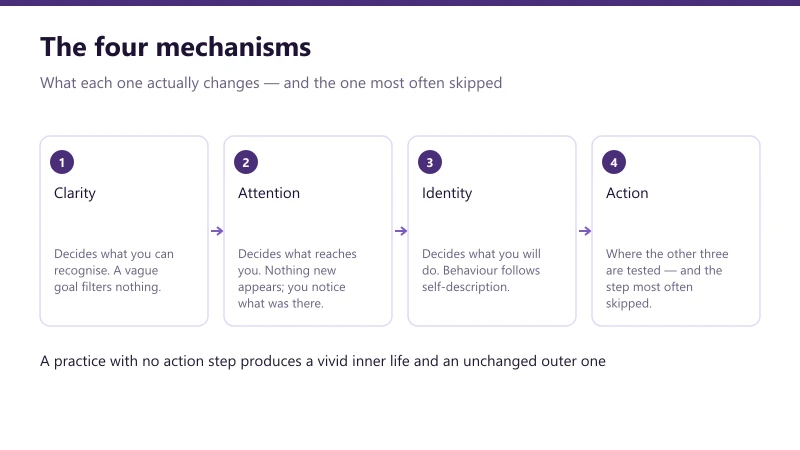
Clarity, attention, identity and action are not four nice words. Each one changes something specific, and knowing which one you are short of is the difference between a practice that moves and one that just feels productive.
A goal you cannot describe in one sentence is one you cannot notice an opportunity for. "I want a better job" leaves you unable to tell whether the message in your inbox is relevant; "I want a role where I write for a technical audience" makes that message obvious. Clarity is not motivational — it is a filter, and a vague filter passes everything and catches nothing.
You cannot perceive most of what is around you, and what gets through is weighted by what you have made salient. This is the mechanism people misread as the universe responding. Nothing new appears; you start noticing what was always there, and you notice it early enough to act. Describing that honestly costs the idea none of its usefulness.
Behaviour follows self-description more reliably than it follows intention. Someone who describes themselves as "trying to write more" negotiates with themselves every morning; someone who describes themselves as a writer does not have that argument. This is the part most methods are really aiming at, whether or not they say so.
And it is the one most often skipped, because the first three feel like progress on their own. A practice with no action step produces a vivid inner life and an unchanged outer one — which is the single most common reason people conclude manifestation does not work.
Most method guides describe what to do and skip who it suits, which is why people cycle through techniques and conclude they are the problem. Four rough profiles, and what each tends to need:
Visualisation-led methods — scripting, SATS, mental rehearsal — give you something to work with. If you cannot see images in your head at all, and some people genuinely cannot, these will feel like failing at a basic step. That is a difference in how you think, not a lack of effort, and written methods will serve you better.
Writing-led methods — the letter method, scripting, a mental diet logged in text — do for you what visualisation does for others. The test is simple: if you work things out by writing them, start there.
Ritual-heavy methods will keep you at arm's length no matter how well they work for others, because performing something you find silly interrupts the state it was meant to produce. Start with the plainest mechanism available — clarity written down, attention directed deliberately, one action scheduled — and add nothing else.
Then the method is not your problem; the schedule is. A two-minute daily practice you keep beats a twenty-minute one you abandon in week two, and the research on habit formation says the same thing about every other behaviour.
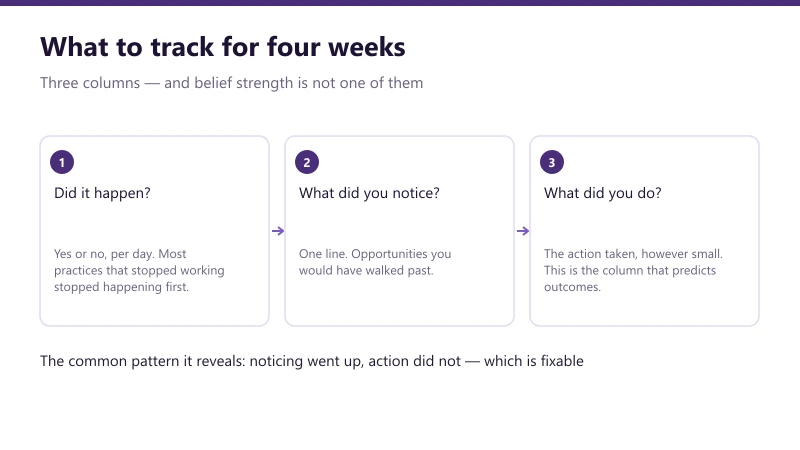
"It is not working" is almost always said without evidence, because almost nobody records anything. Three things are worth tracking, and none of them is how strongly you believe.
Four weeks of those three columns tells you more than any amount of reflection. And the common pattern it reveals is specific: noticing went up, action did not. That is a fixable problem, and you cannot see it without the record.
We publish guides that recommend against particular methods, which is unusual in this space and worth explaining. Four failure modes we think are worth naming:
"You did not believe hard enough" is unfalsifiable and cruel: it explains every failure without predicting anything, and it puts the blame on the person for an outcome the method never controlled. If a framework can only ever be right, it is not telling you anything.
Advice to never think a negative thought creates a monitoring loop — you end up watching for the thought, which is a reliable way to produce it. Doubt is not a leak in the system; noticing it and continuing anyway is the practice.
Nobody can tell you that something arrives in 17 days or three months. Specific timelines are a persuasion device, and their main effect is to set up an arbitrary date on which you decide the whole thing failed.
The methods that produce the most reported results are the ones with a behavioural step attached. Any version that lets you skip the step is pleasant and inert, and it is the version that sells best for exactly that reason.
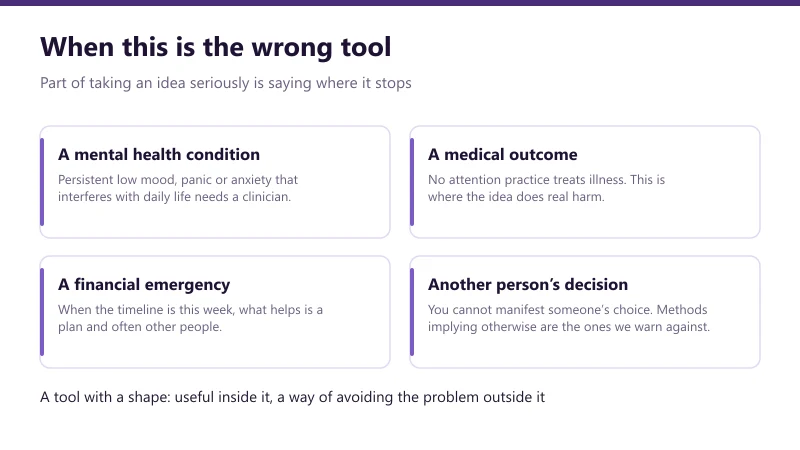
Part of taking an idea seriously is saying where it stops. Manifestation practice is not a treatment, and in these situations it can actively delay something you need:
None of this makes the practice worthless. It makes it a tool with a shape — useful inside it, and a way of avoiding the real problem outside it.
Partly, yes — and that is not the dismissal it sounds like. Confirmation bias is a real mechanism that reliably changes what you notice, and a practice that deliberately aims it at something you chose is doing something, even if the something is ordinary. What the objection correctly rules out is the stronger claim: that attention alone alters events. We do not make that claim anywhere on this site.
Reasonable, and the overlap is large. The difference in practice is emphasis: goal-setting frameworks start at planning and treat self-concept as a side issue, while these methods start at self-concept and treat the plan as downstream. For people whose obstacle is "I do not believe I am the kind of person who does this", starting at the plan has a poor record.
Often true, and it is why this site publishes guides saying a method is not worth your time. A field with no disconfirming content is a sales channel. Judge any source by whether it has ever told you something would not work.
It can, and that is the strongest version of the objection. A practice that feels like progress while nothing changes is worse than no practice, because it uses up the attention a real attempt would need. That is exactly why every method here carries an action step and why we say plainly where the practice is the wrong tool.
Most people start by reading more. Reading more is the one activity reliably uncorrelated with outcomes here. A concrete fortnight instead:
Specific enough that you could recognise an opportunity for it in your inbox. If your sentence needs "and" twice, you have two goals and should pick one for now.
Visual or verbal, five minutes, same time daily. Do not evaluate it yet. Five days is enough to find out whether you will actually do it, which is the only question this week is asking.
Keep the practice and start recording what you noticed and what you did about it. One line each. By day fourteen you will have something almost nobody has: evidence about your own practice rather than an impression of it.
Three outcomes, each with a different next step. If the practice did not happen, the schedule is wrong — shrink it. If it happened but you noticed nothing, the outcome sentence is too vague — rewrite it. If you noticed things and did nothing, that is the common one, and it is the one the action column exists to expose.
Personality quizzes are mostly entertainment, so a word on why there is one here. The eight patterns are not types you belong to — they are descriptions of where a practice tends to break, and the reason to identify yours is that the fix differs.
Each of those people could read the same article and take away the wrong instruction. That is the whole argument for sorting — not that you are a type, but that generic advice is aimed at an average reader who does not exist.
A large share of what people bring to manifestation is about someone else: a reply, a reconciliation, a change of mind. This deserves a direct answer rather than a vague one.
You cannot manifest another person's decision. Methods that imply you can — and several popular ones do — turn a private practice into something aimed at someone, and that is where this material stops being harmless. It also tends to make the practitioner worse off: attention held on a specific person's specific response is attention that keeps the situation live, which is the opposite of what someone waiting for a reply usually needs.
What the mechanisms can honestly do here is narrower and still useful. Clarity about what you actually want from the relationship, rather than from the next message. Attention on your own conduct, which you control. Identity work on whoever you would be if the answer were no — which, unlike the answer itself, is available to you today. And the action step, which in this situation is usually one clear communication rather than fourteen rehearsed ones.
If what you want is for someone to choose you, no practice supplies that. Saying so is not us being strict about the rules; it is the difference between a tool and a trap.
Manifestation is the practice of defining an outcome you want, holding your attention on it deliberately, building the identity and behaviours it requires, and acting consistently in that direction. Clarity, attention, identity and action are the mechanisms — not the intensity of your belief, and not a promise that thinking about something makes it appear.
That is the whole definition. If you want the long version — the difference between the practice and the metaphysical claim, and the four mechanisms doing the actual work — read what manifestation is. If you want to know whether any of it holds up, read does manifestation work.
This is the part you will not find elsewhere. People do not fail at manifestation randomly — they fail in a small number of recognisable ways, and each one needs a different correction. Telling an Overthinker to visualize more makes things worse. Telling an Action Manifestor to sit quietly with an image will not hold their attention for a week.
| Pattern | Natural strength | Main friction |
|---|---|---|
| The Visionary Without a System | Visualization | Consistency |
| The Focused Dreamer | Clarity of desire | Doubt |
| The Inspired Starter | Emotional momentum | Follow-through |
| The Overthinker | Depth of attention | Thinking-to-doing ratio |
| The Action Manifestor | Bias to action | Direction over volume |
| The Scripter | Written processing | Page-to-world transfer |
| The Identity Builder | Self-awareness | Waiting to feel like the person first |
| The Clarity Seeker | Openness | A moving target |
Four questions is enough to tell them apart, and the result names your natural strength, the friction point your answers actually point to, and one thing to try today. Take the quiz — it is free and there is no email gate. If you would rather read first, each pattern has its own page: start with what type of manifestor you are.
Pick the door that matches what you came for.
| If you want to… | Go here |
|---|---|
| Know what manifestation actually is | What is manifestation |
| Start from zero, properly | Manifestation for beginners |
| Follow a step-by-step process | How to manifest |
| Compare the techniques | Manifestation methods |
| Understand why yours stalled | Why it is not working |
| Work on money | Manifest money |
| Work on love | Manifest love |
| Work on career or business | Manifest a career |
| Work on how you see yourself | Self-concept |
| Build a daily practice | Manifestation routine |
You need one system built around what you actually want.
Take the 4-Question QuizWhat's blocking your manifestation?
Free quiz